Tests and diagnosis for liver cancer
The tests used to diagnose liver cancer help doctors understand your condition, where the cancer is located, whether it has spread, and what the best treatment will be for you. No matter where you are in your experience, it can feel overwhelming. You or your support network can ask questions as often as you need to.
Several types of scans may be used to look at your liver and nearby organs.
There are different ways to stage primary liver cancer.
In Australia, the common staging systems are the Child-Pugh score and the Barcelona Clinic Liver Cancer (BCLC) system.
Treatment should start within four weeks of diagnosis, depending on how urgent it is and what type of treatment is recommended.
Types of tests for liver cancer
Diagnosing liver cancer can be complex and often needs several different tests. Your specialist will choose the best tests for you.
If you go to your doctor with symptoms like pain in your tummy and yellowing of your skin, your doctor may perform a physical examination to check for signs of disease.
A physical examination is a check-up, where your doctor will look for things like lumps, swelling or anything else that seems unusual. They will ask you about your medical history, family history and your health habits.
You will have blood tests as part of the initial set of tests. Blood tests can check:
- your blood count
- how well your liver and kidneys are working
- your general health.
Some blood tests can also check for tumour markers, which are chemicals produced by cancers that show up in the bloodstream. For example, alpha-fetoproteins are tumour markers linked to liver cancer. However, other conditions can also raise the levels of these markers, and some people with liver cancer have normal levels. These markers on their own cannot be used to diagnose liver cancer.
Several types of scans may be used to look at your liver and nearby organs.
- An ultrasound uses soundwaves to create a picture of the inside of the body. A probe is moved over your abdomen and shows images of your liver, pancreas, gallbladder and bile ducts.
- A computed tomography (CT) scan uses X-rays to build 3D pictures of your liver and nearby organs. This scan usually also includes your chest and pelvis to check if cancer has spread.
- A magnetic resonance imaging (MRI) scan uses magnets and radio waves to build detailed pictures of your liver and surrounding areas.
- A magnetic resonance cholangiopancreatography (MRCP) is a special type of MRI scan. It can make clearer pictures of the bile ducts and help see any blockages.
- A positron emission tomography (PET) scan uses a small amount of radioactive substance that is put into a vein. It can help to find very small areas of cancer cells. You may have a PET scan combined with a CT scan.
- A bone scan may be needed if you are planning to have a liver transplant or have pain in your bones. Like a PET scan, a small amount of radioactive substance is injected to show areas where cells are more active.
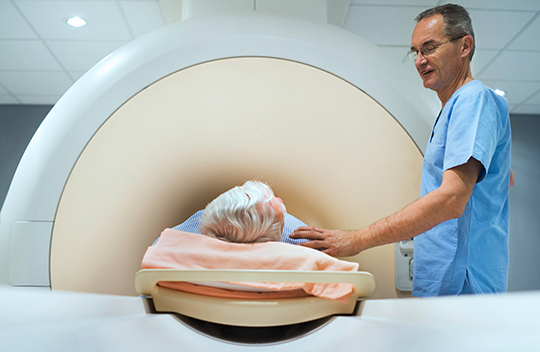
Some tests for liver cancer use special equipment.
- During an Endoscopic Ultrasound (EUS), a thin, flexible tube with an ultrasound probe is passed through your mouth into your stomach. This gives close-up pictures. It can also be used to take a biopsy (small tissue sample).
- A laparoscopy is a small operation done under general anaesthetic. A long tube with a camera is inserted through small cuts in your abdomen to check whether the cancer has spread. Small tissue samples (biopsies) can also be taken during this procedure.
- A tissue biopsy is needed to confirm the diagnosis of cancer and to get as much information as needed for treatment planning. Tissue samples for examination under a microscope can be taken during an ultrasound, through your skin with local anaesthetic, or during a laparoscopy.
A biopsy may not be performed in certain cases when surgical removal is planned upfront. In cases when surgery is not planned at the beginning, you will need to have a biopsy before starting chemotherapy or taking part in a clinical trial.
Even if you have had an urgent referral for a test, you may have to wait days or weeks for your appointment. It is also common to have to wait for test results. Waiting can be frustrating and worrying, especially if you are already unwell.
However, it is unlikely that your cancer will grow enough during this waiting period to cause you further harm if your symptoms are otherwise stable. It is still a good idea to ask your doctor how long you may have to wait. If you think you have been waiting too long or have any concerns, check with your doctor.
If your symptoms get worse or you start to feel more unwell while you are waiting, it is important to get in touch with your doctor. If you can't see your doctor and you can't control your symptoms at home, you may need to go to the emergency department.
This waiting time can be hard. If you'd like someone to talk to, our team is here.
Call us on 1300 881 698 or send us an email support@pancare.org.au
Genetic testing
Most liver cancers are not caused by genes that are passed down in families. They usually happen because the liver has been damaged over time. For example, by infections like hepatitis B or C, or by conditions such as cirrhosis (scarring of the liver), fatty liver disease, or heavy alcohol use.
Some rare inherited conditions can make liver cancer more likely. These include:
- Haemochromatosis – a condition where the body stores too much iron.
- Alpha-1 antitrypsin (AAT) deficiency – a condition that can affect the liver and lungs.
There isn’t a regular genetic test to check for liver cancer risk in Australia. Doctors may suggest testing only if someone has one of these rare conditions or a strong family history of liver problems.
Sometimes, doctors may test a liver cancer tumour itself to look for genetic changes. This helps them understand how the cancer behaves and which treatments might work best. These tests are still new and not done for everyone.
If you are worried about family risk or want to know more about genetic testing, it’s best to talk to your doctor or a genetic counsellor. They can explain if testing is needed and what the results might mean for you and your family.
You can find more information about cancer in families and genetic testing at the Centre for Genetics Education
What does staging liver cancer mean?
Once liver cancer is found, your doctors need to work out how far the cancer has spread. This is called staging.
Staging helps your medical team:
- understand how much cancer there is in your body
- plan the best treatment
- predict how you may respond to treatment.
There are different ways to stage primary liver cancer. In Australia, the common staging systems are the:
- Child-Pugh score
- Barcelona Clinic Liver Cancer (BCLC) system
The Child-Pugh score measures how well the liver is working. This is important because liver cancer often occurs in people who already have liver damage.
- Stage A: The liver has some damage but is working well.
- Stage B: The liver is working moderately well.
- Stage C: The liver is very damaged and is not working well.
The BCLC system combines information about the cancer, liver function, and your overall wellbeing to guide treatment decisions.
- Stage 0 (Very early): There is only one tumour and it is less than 2 cm across. You feel well and are fully active. (Equivalent Child-Pugh score: A)
- Stage A (Early): There is only one tumour and it is greater than 2 cm across, or there are up to 3 tumours and they are all less than 3 cm across. You feel well and are fully active. (Equivalent Child-Pugh score: A or B)
- Stage B (Intermediate): There are multiple tumours in the liver. You feel well and are fully active. (Equivalent Child-Pugh score: A or B)
- Stage C (Advanced): The tumour has grown into one of the main blood vessels of the liver, or it has spread to the lymph nodes or other organs. You do not feel well and are less active. (Equivalent Child-Pugh score: A or B)
- Stage D (End-stage): The tumour has grown into one of the main blood vessels of the liver, or it has spread to the lymph nodes or other organs. The liver is very damaged and you are unable to look after yourself. (Equivalent Child-Pugh score: C)
Your specialist will explain what stage your cancer is at and what this means for your treatment options.
Finding out you have liver cancer
Being told you have liver cancer can be overwhelming. There is no ‘right’ way to feel – everyone reacts differently. You may feel:
- shock and disbelief
- fear and worry
- anger
- sadness
- fear and uncertainty for the future
All of these reactions are normal.
A lot can happen quickly after diagnosis, and you might get lots of information. It's okay if you don't remember everything you're told or need information repeated.
When you need to chat, our team can help you make sense of what the next steps look like.
After your diagnosis, your medical team will finish any remaining tests that are needed. They will then talk to you about the treatment plan best suited to your situation.
Treatment should start within four weeks of diagnosis, depending on how urgent it is and what type of treatment is recommended.
Here are some questions that you may want to ask your healthcare team as you come to terms with your diagnosis and think about your treatment options.
- What type of liver cancer do I have?
- Where in the liver is the cancer located?
- Has the cancer spread, and what stage is it?
- How does this stage affect my treatment options and outlook?
- What treatments are recommended for my situation?
- Can I get a second opinion?
- What is the goal of treatment? Is it to remove the cancer, slow its growth, or manage symptoms?
- What are the benefits and risks of each option?
- How likely is the treatment to work in my case?
- Are there other treatments I should consider (including clinical trials)?
- What happens if I decide not to have treatment?
Learn more about what happens next through your My Care KIT.
Want to talk?
Speak with a specialist cancer nurse, dietitian or counsellor, whether that's understanding a diagnosis, managing day-to-day, tips on managing your diet or just needing someone who understands. Free support for anyone impacted by upper GI cancers, Monday to Friday, 9am to 5pm.