Tests and diagnosis for oesophageal cancer
You may need to have several tests when you are being investigated for oesophageal cancer. These tests help your healthcare team understand whether there are cancer cells in your oesophagus, what type of cancer it is, and whether it has spread to other parts of the body. This information is vital in planning the most effective treatment for you. It can take time to complete all the necessary tests. Waiting for appointments and results can be stressful. But this process helps ensure your doctors have a clear and accurate understanding of your condition.
If you go to your doctor with symptoms like difficulty or painful swallowing, blood in your vomit or worsening reflux, your doctor may perform a physical examination to check for signs of disease.
An endoscopy (also called gastroscopy or oesophagoscopy) is the main test used to diagnose oesophageal cancer.
Most cases of oesophageal cancer are not caused by inherited (genetic) factors. They usually happen because of lifestyle or environmental causes.
Once oesophageal cancer is found, your doctors need to work out how far the cancer has spread. This is called staging.
Types of tests for oesophageal cancer
If your doctor suspects that you have oesophageal cancer, you may need to undergo several different tests. Your doctor will choose the best tests for you.
If you go to your doctor with symptoms like difficulty or painful swallowing, blood in your vomit or worsening reflux, your doctor may perform a physical examination to check for signs of disease.
A physical examination is a check-up, where your doctor will look for things like lumps, swelling or anything else that seems unusual. They will ask you about your medical history, family history and your health habits.
You will have blood tests as part of the initial set of tests. Blood tests can check:
- your blood count
- how well your liver and kidneys are working
- your general health.
Blood tests alone cannot diagnose oesophageal cancer, but they provide important information about your overall health.
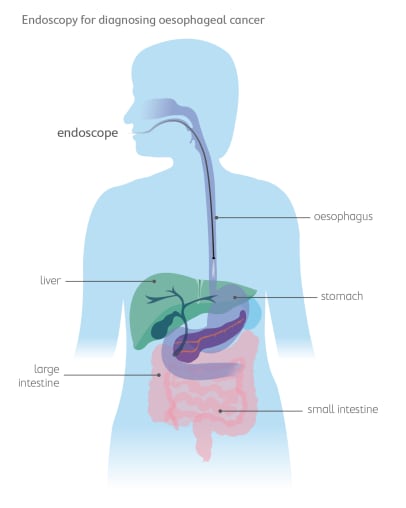
An endoscopy (also called gastroscopy or oesophagoscopy) is the main test used to diagnose oesophageal cancer.
An endoscope is a thin, flexible tube with a small camera on the end. While you are sedated (asleep), the doctor will slide the endoscope down your throat to look for abnormal areas in the oesophagus and stomach.
The doctor will also take a small tissue sample during this procedure. This is called a biopsy. The biopsy is sent to a pathologist who looks at it under a microscope to check for signs of cancer.
After your endoscopy, you may need to be booked for an endoscopic ultrasound (EUS) to see whether the cancer has spread to the surrounding lymph nodes, or deeper into the oesophagus or stomach tissue. EUS uses an endoscope with an ultrasound probe at the end, which uses soundwaves to create a picture of the inside of the body. The doctor may also take a biopsy during the procedure. The result can help doctors better assess the cancer.
A laparoscopy is a small operation done whilst you're asleep under general anaesthetic. A long tube with a camera is put in through small cuts in your tummy. This lets doctors see if cancer has spread. Small tissue samples (biopsies) can also be taken during this procedure.
Several types of scans may be used to look at your oesophagus and nearby organs.
- A Computed Tomography (CT) scan uses X-rays to make 3D pictures of your oesophagus and nearby organs. This scan usually also includes your chest and pelvis to check if cancer has spread.
- A Positron Emission Tomography (PET) scan uses a small amount of radioactive substance put into a vein. It can help to find very small areas of cancer cells. You may have a PET scan combined with a CT scan.
- A Magnetic Resonance Imaging (MRI) scan uses magnets and radio waves to make detailed pictures of your oesophagus and the soft tissue nearby.
Results should be ready within two weeks of having the tests. Waiting can be stressful. If your symptoms get worse while waiting, contact your doctor or go to an emergency department if needed.
Even if you have been given an urgent referral, you may have to wait days or weeks for appointments and results. This is common. Any cancer growth during this waiting period is unlikely to cause additional harm if your symptoms are otherwise stable. However, it's still important to ask how long you may have to wait.
Genetic testing
Most cases of oesophageal cancer are not caused by inherited (genetic) factors. They usually happen because of lifestyle or environmental causes. However, in a small number of people, oesophageal or stomach cancers can run in families due to a change in a gene that increases cancer risk.
If you were diagnosed at a young age, have a strong family history of cancer, or if your doctor thinks your cancer type may be linked to a genetic cause, you may be referred to a familial cancer service. These specialists can review your personal and family history to see if genetic testing is right for you.
Genetic testing looks for changes in genes that may increase the risk of certain cancers. If a genetic change is found, your family members can also be tested to see if they carry the same change. Support and counselling are provided before and after testing to help you understand what the results mean for you and your family.
You can find more information about cancer in families and genetic testing at the Centre for Genetics Education.
What does staging oesophageal cancer mean?
Once oesophageal cancer is found, your doctors need to work out how far the cancer has spread. This is called staging.
Staging helps your medical team:
- understand how much cancer there is in your body
- plan the best treatment
- predict how you may respond to treatment.
In most cases, the stage of a cancer is based on three factors:
- the location and size of the tumour (T)
- whether or not the cancer has spread to nearby lymph nodes (N)
- whether or not the cancer has spread to distant areas of the body, known as metastasis (M).
These combined factors are known as the TNM staging system.
Your doctor might also use a number between 1 and 4 to describe the stage of your cancer.
- Stage 1: The earliest stage. Tumours are found only in the lining of the oesophagus. Also called early oesophageal cancer.
- Stage 2: The cancer has spread deeper into the layers of the oesophagus.
- Stage 3: The cancer has spread to nearby lymph nodes. Also called locally advanced oesophageal cancer.
- Stage 4: The cancer has spread beyond the oesophagus to nearby lymph nodes or parts of the body, or to distant lymph nodes and parts of the body. Also called advanced or metastatic oesophageal cancer.
Finding out you have oesophageal cancer
Being told you have oesophageal cancer can be overwhelming. There is no ‘right’ way to feel – everyone reacts differently. You may feel:
- shock and disbelief
- fear and worry
- anger
- sadness
- fear and uncertainty for the future.
- All of these reactions are normal.
A lot can happen quickly after diagnosis, and you might get lots of information. It's okay if you don't remember everything you're told or need information repeated.
After your diagnosis, your medical team will finish any remaining tests that are needed. They will then talk to you about the treatment plan best suited to your situation.
Treatment should start within four weeks of diagnosis, depending on how urgent it is and what type of treatment is recommended.
Here are some questions that you may want to ask your healthcare team as you come to terms with your diagnosis and think about your treatment options.
- What type of oesophageal cancer do I have?
- Where in the oesophagus is the cancer located?
- Has the cancer spread, and what stage is it?
- How does this stage affect my treatment options and outlook?
- What treatments are recommended for my situation?
- Can I get a second opinion?
- What is the goal of treatment? Is it to remove the cancer, slow its growth, or manage symptoms?
- What are the benefits and risks of each option?
- How likely is the treatment to work in my case?
- Are there other treatments I should consider (including clinical trials)?
- What happens if I decide not to have treatment?
Learn more about what happens next through your My Care KIT.
Want to talk?
Speak with a specialist cancer nurse, dietitian or counsellor, whether that's understanding a diagnosis, managing day-to-day, tips on managing your diet or just needing someone who understands. Free support for anyone impacted by upper GI cancers, Monday to Friday, 9am to 5pm.